





Advertisement
|
Straight From the Mouth
The Morning Mouth's April Interview with Ed Schultz
(Reprinted by permission; Copyright © 2004 Talentmasters Inc.)
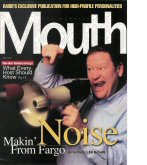
Whatever you do, don't call Ed Schultz a left-wing talk host. That's not how he sees it. Rather, call him a progressive Democrat who describes his audience as the kind of people who take showers after they get home from work. And while it seems that he's making a lot of noise on the left, to his fans at KFGO/Fargo, he's been loved on both sides of the aisle long before his national attention. Today, in addition to Fargo, where he does a daily morning show as well handle operations, he also airs an afternoon show on 20+ other affiliates, plus XM and Sirius Satellite Radio. This month's interview isn't about politics. It's about a personality who apparently is defying the myth that market-size limits your chances to be noticed.
Ed, before connecting with you, I made sure your publicist visited our web site so she'd understand that we're about personalities, not politics. Afterall, with a name like "The Mouth," there could be cause for confusion. Bring us up to speed on your career as a personality. Everything from radio and TV sports, outdoor shows to football, basketball play-by-play... I feel like done just about everything except weather.
Was sports your entry into broadcasting?
Yeah, I was a football player in college (Morehead State University in Morehead Minnesota. Now it Minn. State University-Morehead). From there I did some NFL tryouts and then I just kind of got into sports broadcasting and I just evolved into what I'm doing today. In the 90's I thought TV sports was kind of a young guy's game, I got tired of the redundancy and I wanted to do something different. So, I started doing talk radio in '92. In '96 I went to KFGO, got regionally syndicated and have been since.
When are you on in Fargo?
From 8:30-11am (CT).
What about numbers?
My shares have fluctuated from a 24 to a 32 share. In my last book, I had
Advertisement
|
So how did the national thing happen?
I got a phone call from Democracy Radio in Washington and they wanted to bring in all the progressive talk hosts in the country to talk about the State of the Union Address that was coming up in January, 2002. So, my wife and I went to Washington and I had my opportunity to talk about the industry, why there's so much conservative talk going on. After I gave my pitch, they came up to me asked if I would consider national syndication. Had you always been known for your liberal brand of show? No, actually I was a conservative till about '98. But since about '98, I became very much a Democrat. But my shares haven't changed a bit. In fact, they've gone up in the last year. And right now, we've got more competition than ever. I just think good radio is good radio. You either know how to do it, or you don't.
There are things set in concrete you must have if you're going to be successful. Politics has nothing to do with it, or where the host stands on the issues.
A listener gravitates to the personality. They relate to him or her, they like or dislike them. They find them entertaining, interesting to listen to with relevant information -- you've gotta have those ingredients. What I think is a radio show has gotta have taste; personality, activity, communication and entertainment. And you have to have pace. The show's gotta move, it can't drag. So this has kind of been my formula.
A good talk show host knows when they've had a good show. They also know when things aren't going well. And everyone has their peeks and valleys.
How much time do you spend preparing for your shows? And given that you do both a morning as well as afternoon show, I've got to believe you spend a lot of time reading.
Well, one of the reasons I felt I could do this was because it didn't break one of my golden rules. That is, for ever hour you're on the air, you've got to have at least an hour of preparation. That's minimal. You're constantly reading, listening, making phone calls, making contacts, formulated opinions, watching the news and figuring out how this is going to play vs. that, but with the listener in mind! The two most important words in
Advertisement
|
Since you're on two satellite stations, what's your feel on its future?
I think we're in the audio business. Not just the radio, but audio business.
How about the people who listen? Are they there?
Oh they're definitely there. They are definitely there. I'm gettin' calls from all over the country. I don't think there's a state I haven't gotten a call from. I have noticed that most of them are male.
Since going national, has your level of guests improved?
Yeah, it's a lot different when they take your calls. A lot different. When I was just doing a show in Fargo and in the region, I would just connect with people from this area. Now, I'm entering into new territory. But look, we follow the news. I don't just call up Senator Daschle's office and say "Hey, do you think Tom can hook up with us on the radio?" I refuse to program a show like that. We have to know "What is the story today?"
...I don't like long interviews unless they're good. And they have to sound good. You have to have a good connection? How good is this person? How good is their sentence structure, are they cuttin' to the chase? Is this interesting? There's a constant evaluation going on when you're talking to somebody in an interview. You gotta recognize good radio when it's happening.
Given where show is positioned, can a liberal talk network be successful?
I don't know. We already know the concept of conservative talk radio works. There's stations around the country that have nothing but conservative shows and they have ratings. So, that's been proven. But it still comes down to the talent. And it still comes down to is the show compelling? Does it have pace? Does it move? Does it have personality driven entertainment -- when the rubber meets the road, you better be able to debate the issues cause that day will come. You can't just say "Caller, what do you think?" You've gotta be able to expouse some opinions out there and back them up with facts and be able to formulate it to the listener so they understand where you're coming from and do it in a compelling manner that moves the show. You've gotta be issue driven and well researched -- off the top of your head. You can't write this stuff. You can go in with some written outline, but your comments have to come from the heart with passion that's real.
After you leave the station, do you leave politics, or your show back at the office?
You never leave the office -- not if you wanna be good. The office is in your head.
What about when you're out in public and you encounter listeners who wanna continue a discussion you had on air?
I'm always listening. I'm always looking for something interesting.
How powerful is talk radio?
If Richard Nixon had had these conservative talkers from 9am to midnight on hundreds of radio stations across the country, I don't think he would have resigned. That's how powerful I think talk radio is. I think it effects local elections; regional elections. And I believe talk radio can impact national elections.
Do you ever listen to other talk shows?
Yeah, I listen to (Rush) Limbaugh, (Sean) Hannity; we tape the show and I get a flavor of it everyday.
Do you listen primarily for their talking points?
No, but it's interesting to hear their take on things. But I'm also listening to their techniques; their content.
Having caught your show lately, I've noticed you reminding yourself to avoid sound angry. Is that schtick?
Well, I've had a couple of Program Directors say that "He sounds angry." I told some people "That's what they're being told and they're regurgitating it. Why is it when I get passionate or aggressive on the air, they say I'm angry. But if a conservative talker does it, they're good Americans." So, I've used this anger alert to redefine and bring the argument back through a comical manner and try to drive a point home. And I think it's catching. Plus, it's funny.
You've been featured lately in a number of publications -- name a few?
I was in Esquire; The Dallas Morning News; LA Times, Detroit Free Press, Buffalo News, Minn. Tribune and The St. Louis Dispatch.
Is the interest in you, or the attention to non-conservative talk shows?
There's been a great deal of curiosity. When Bob Kursin from Esquire came to to Fargo last November to do story, he sat in my studio for a full day. Afterwards, I asked him, So what do you think? "Tell me the truth. He said "There's nothing like this in Chicago. It's a great product." Then, Coleen Nelson shows up from The Dallas Morning News, she said the same thing. Stephanie Simon from The LA Times, when I asked her the same question, she said "This is gonna go, this is really going to go. If you can crack the industry, this is going to go."
What do you say to someonw who's unsure of putting on a show that's different in content from their other shows.
You know what, I put Rush Limbaugh on KFGO. KFGO is a heritage station -- live and local. I'm the Operations Manager here also. In August, I put Rush on KFGO. You know what we found out? An integrated format works. Plus, it brings new people to your station. Anytime you do something different and shake up the market, you're going to get new sampling and you've got a chance to win 'em over. I'm on from 8:30-11am; Limbaugh 11-2pm and then we have Jack and Sandy from 2-6pm. We have a 17.5 share!
Who else does the show with you?
My board Op' is named Tank. My producer is James Holme; my wife, Wendy and that's it.
It's obvious, you have a passion for sports as well as politics. Given where we are with college basketball playoffs, I have to ask, who does it come down to? (Recorded prior to 4/1/04)
Oklahoma State.
And the Presidential election?
7 months is an eternity in politics. It's just to early to tell.
Advertisement
|
Advertisement
|
Advertisement
|
Advertisement
|
|
Copyright © 1989-2026 RADIO ONLINE ® |

