





Advertisement
|
Straight From the Mouth
The Morning Mouth's November Interview with Ace & TJ
(Reprinted by permission; Copyright © 2003 Talentmasters Inc.)
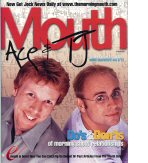
Recently, when the FCC held it's first localism hearing in Charlotte, TJ's name popped up in the news. I haven't seen many jock's names associated with that forum. Why did you attend?
TJ: We felt whatever goes on in those things could change how our careers go. It was something that we felt we needed to be a part of since it could affect our industry directly.
What was your sense of how those in attendance felt about radio?
Ace: To me, everyone that spoke there had an agenda. I didn't think that they had any thoughts on radio in general. They either came in to support their local station based on their charity drives, or, those who came with an axe to grind over a specific cause. A local artist was there to say that they should have more access to radio.
The most frustrating thing there was that there were no programmers present on either of the two panels that spoke. They had local artists and a OM, some owners, but no personalities, and no programmers who are in the trenches everyday dealing with music and how it is done. Yet, everyone is allowed to voice their opinion, and most of the negativity was on their access from a musical standpoint to radio.
TJ: No one was there to refute that. My main point was doing things for the community as a radio station, the things we do to help sick children and families in need and disaster victims. The most important thing to me is doing things for the community versus putting someone's record on the radio and making them millions of dollars.
Did you find as a personality speaking out that people like Michael Powell and others on the panel were curious of your input?
TJ: Actually I think that Chairman Powell was enjoying the debate.
Why do you think that there were not more programmers there speaking on the behalf of radio?
Advertisement
|
Ace: Honestly? I don't think they thought of bringing in a programmer in to explain how it works. They had someone from radio, someone from television, a local artist, someone from public funded radio, and public funded television, and they never considered the people who do it everyday. They automatically went to the business people. They completely bypassed and didn't take into account the expertise and intelligence that a morning show or a programmer could bring to the table. Its another case of the higher ups not giving enough credit to programming for being able to make an intelligent argument.
Since we're on this subject, how did you feel about the whole Dixie Chick's issue?
TJ: They have a right to do that just as the business owner, i.e. the radio station has a right not to sell their products. With the whole Dixie Chicks thing, people were saying it was freedom of speech, no one told them that they couldn't say it. But if people don't agree with them, I am not going to put them out there and harm my business just because they have an opinion. No one said that they needed to shut up or we never did. With the freedom of speech also comes the freedom to accept the consequences.
You're known for both your comedic content, as well as, community causes. Which do you enjoy more?
Ace: I can't speak for TJ, but for me and what we did as a radio station for the family of the Anthony Stancil the slain officer, is certainly the most gratifying. The fact that you can help motivate people to raise over $200,000 for someone they didn't even know, you have served your purposes on two fronts, you have helped someone who desperately needed help and it reinforces the fact that people really do care. Officer Stancil was working a night job filling in for someone, a guy stole $11 worth of crablegs and Stancil grabbed him in the parking lot to apprehend him and the guy turned and shot him in the face. Stancil had two children and one on the way. We went on the air talking about it and decided and that we would take the money out of our pockets and give to a fund. While we were counting our money, someone else called to give money and by the end of the afternoon we had raised over $200,000 and tied up all the traffic in the street near the radio station.
Advertisement
|
Because of your history with public causes, has it prompted more people to contact you?
TJ: We have so many letters and things that start with "I know ya'll like to help people, so here's my situation..."
Ace: Its great until you get that letter that says "I know ya'll like to help people. My family is in financial trouble, my husband's car note is $680 per month and mine is $ 590 a month. And they are going to be repossessed." On top of that they want to go on vacation.
How many years have you been in Charlotte?
TJ: Five and a half.
Five years ago, you were 13th in the market, now you're number 1. How do you explain your success?
TJ: Ever since we were on at WZYP/Huntsville, we have figured out that the only thing we can do is what we know to do and that is to use our own personalities to get people to like us. So when we came into Charlotte we wanted to make sure that people didn't think we were trying to be another John Boy and Billy. In Huntsville, we did a lot of characters and voices. But when we came here, John Boy and Billy had that market cornered so we started relying more on conversational, observational humor and bringing more listeners in on the phones and things like that. It was different from what Charlotte had at the time. It was an opportunity to make a splash being the new show and all.
Was there a turning point?
Ace: We had been here 6-8 months and were starting to see growth. Then one didn't tell the audience what was happening and got the guy some help. After that, we got a write-up in Readers Digest and the local paper. From there, things just started growing. Then the Stancil thing happened and it all ignited. For three days we were the lead story on every news station in town. We were on the "Today Show." Ted Nugent was calling wanting to put us on his radio show. It all happened so fast.
One of my favorite radio stories is from your "lean years" back at KQID/Alexandria, LA. Didn't one of you promote yourself to the morning show because there was no one there to do it.
TJ: After everyone on the air staff had quit, they made Ace the PD and I already was the APD and one of us would do mornings and the other afternoons. I also did nights. We wanted to be a morning show and they never would let us. So, after everyone had quit and there was only two of us left, I joined the morning show. They didn't have much of a choice.
Where was the point in your career where you felt you were going to make it?
Ace: For me, Morning Show Boot Camp 1996. Kidd (Kraddick) had us on The Morning Mouth panel which he moderated. Jeff & Jer, Bert Weiss and other big names were on it and then us. It was the feature panel of the day. We just started answering the questions and talking, and the people laughed and really responded to some of the things we were talking about. It gave me a great deal of confidence in our approach at that point. Because if those people on that panel and in that room thought what you were doing was good and different, then there must be something there. When you stand before that audience at Boot Camp, that's the greatest radio talent in the business and if they enjoy it then you must be doing something right.
Looking back, is there anything you would have done differently in your career?
TJ: I would have cut my mullet long before I did.
Who in the business do you owe the greatest debt of gratitude?
Ace: Very early in our radio careers, Hollywood Harrison, was very instrumental in our beginning. Kraddick and Jeff and Jer were huge influences. We asked them to join us for breakfast during Boot Camp and they spent two hours with us and we have been friends ever since.
Which elements of your show do you rely on most?
TJ: The thing we rely most on are our lives no matter how exciting or boring. There is always a good response with in show competition. You take everyone's character traits and they all come out in whatever in show competition that you have. A couple of weeks ago we did a bit called the Ace and TJ's swingers club. We spun a wheel and we all ended up going out on a real date with the other people's significant other. It was a full fledged pick you up at the door and take you out and report back on Monday morning. We spun the wheel on Wednesday so that by Friday everyone knew that some plans had been made. We had Wednesday, Thursday and Friday to tease the thing and then held them on until Monday and listen for an hour and a half while we recapped. Pete got my wife drunk, who is usually all prim and proper. I went out with our Producer Ryan's girlfriend, she is 25 and a party girl, and here I am a 34-year-old man trying to keep up with her and her friends all night. Ace went out with Angie on our show. They have this love hate relationship on the show, more hate than love. Ace's wife had to go out with Angie's husband. Everyone reported back about how they did.
Who all is on the show with you?
Ace: Us, Pete Herrick, Angie, Ryan Johnson, his uncle is Davey Johnson the baseball manager. His parents are great people if you want to print that. He is like the producer basically and handles all our web site stuff, and production. Pete is the Executive Producer and Director of Syndication Operations. Angie has been with us 4 years. She had been working for Mancow. So we called her, liked her and brought her down for an interview and gave her the job.
Pete, I keep hearing you in the background. What's your story in coming to the show?
Pete: I first met Ace & TJ in Alexandria, Louisiana, in 1994. They (as PD and APD/MD) hired me to do afternoons. I liked the morning show, so I started helping out doing some stunts and booking guests. I left to go back to Illinois in '95. In late '97, they called and said they had finally gotten a gig (new contract in Huntsville) where they could hire a producer. I joined them. Waited out a non-compete in Huntsville, then in Birmingham, then the Charlotte show came open and we ended up here 5 1/2 years ago. We all started in Charlotte together in April '98. It's been a great ride!
Lots of thought in this issue about keeping good morning show relationships. Any thoughts?
TJ: Keep it all bottled up and take it out on your spouse when you get home.
Where do you see the business and yourselves 10 years from now?
Ace: Ten years ago I could probably have answered that. Today? No one knows what is going to happen day to day, let alone ten years from now.
Leave us with a couple of bits every show should try? done it, but they should definitely try The Wheel Of Kissing. This is where you get a deck of cards an everyone on the show has to walk over and pick one; low card here loses. We then put everyone else's name on a wheel and spun the wheel and those two people had to kiss. It was huge!
Ace: Pete and I ended up having to kiss.
TJ: There is something that we do called Am I Normal? It's just something you do that you have never talked about to anyone else but just wondered if anyone else does it. Some kind of weird habit. All you need is an example to get us started.
BTW: Was Ace a good kisser?
Pete: No!
Advertisement
|
Advertisement
|
Advertisement
|
Advertisement
|
|
Copyright © 1989-2026 RADIO ONLINE ® |

